
Posted on Jul 31, 2026, 12:21:19 PM by AGC Heat Transfer | 5 min. read
You’re running a food or beverage facility and you've been asked to support a new product launch, push increased volume, or cut changeover time. Your plate and frame heat exchanger efficiency is one of the first things that will tell you whether your system is ready.
It might not be obvious. Sometimes it shows up as longer CIP cycles, more frequent temperature alarms, or a pressure drop that didn't used to be there.
The problem usually isn't the equipment itself. More often, it's that the system was designed for a product and throughput that no longer matches what you're running. Here's what's driving that gap, and how to close it before it costs you uptime.
Why "Business as Usual" Heat Transfer Fails When Products and Volumes Change
Small changes on the production floor have a way of producing outsized problems in heat transfer. A formulation tweak might increase viscosity. A new ingredient could raise fouling risk. A 20% volume increase for a seasonal campaign can change things.
None of these feel dramatic in isolation, but each one can push a plate and frame system past what it was originally specified to handle.
The result might be fouling that wasn't there before, inconsistent outlet temperatures, pressure drops that limit flow, or CIP cycles that run longer than your schedule allows. According to New Food Magazine, a 10% reduction in heat exchanger efficiency can increase operational energy costs by 20%–30%. By the time these symptoms surface, you've likely already been running at reduced efficiency for some time.
The goal isn't to over-engineer your system in anticipation of every possible change. It's to know what to look at before you commit to a new product or volume target, so you're making decisions based on data rather than discovering problems mid-run.
Three Trends That Stress Heat Transfer Systems
Emerging Ingredients and Evolving Formulas
Consumer demand is pushing producers toward more complex formulations — plant-based proteins, alternative fats, natural sweeteners, functional additives. Many of these ingredients behave differently under thermal stress than the products they're replacing.
Higher viscosity reduces turbulence in the plate channels, which directly impacts the heat transfer coefficient. Proteins and starches increase fouling rates. Particulates — even fine ones — can lodge in narrow plate gaps and create localized hotspots or blockages. If your system was specified for a simpler product and you're now running something more complex, that spec gap has real consequences for plate and frame heat exchanger efficiency.
Volume Volatility: Seasonal Spikes, Promotions, and Growth
Running more volume through the same system doesn't just mean more product — it means more heat load, more pressure demand, and less margin for error. A heat exchanger that performs well at steady-state capacity may struggle to maintain target temperatures during a spike, especially if approach temperature has already crept up due to fouling.
This is where knowing your system's actual operating headroom matters. Design capacity and real-world capacity aren't the same number once a system has accumulated some runtime.
Faster Changeovers and Tighter Sanitation Expectations
Retailers and co-manufacturing agreements increasingly specify shorter changeover windows. That pressure lands directly on clean-in-place (CIP). If your cleaning cycle is already at the edge of your allowable downtime, any reduction in CIP effectiveness — from fouled plates, degraded gaskets, or inadequate flow velocity — creates a problem that's both an operational and a food safety concern.
As Dairy Processing notes, one practical way to gauge CIP effectiveness is to track the time between cleanings. If that window is shrinking, your heat exchanger is telling you something. Clean-in-place performance is directly tied to plate condition and system configuration. If your CIP is taking longer than it used to, or you're seeing incomplete cleans, the heat exchanger is worth a close look.
What to evaluate before you change products or push more volume
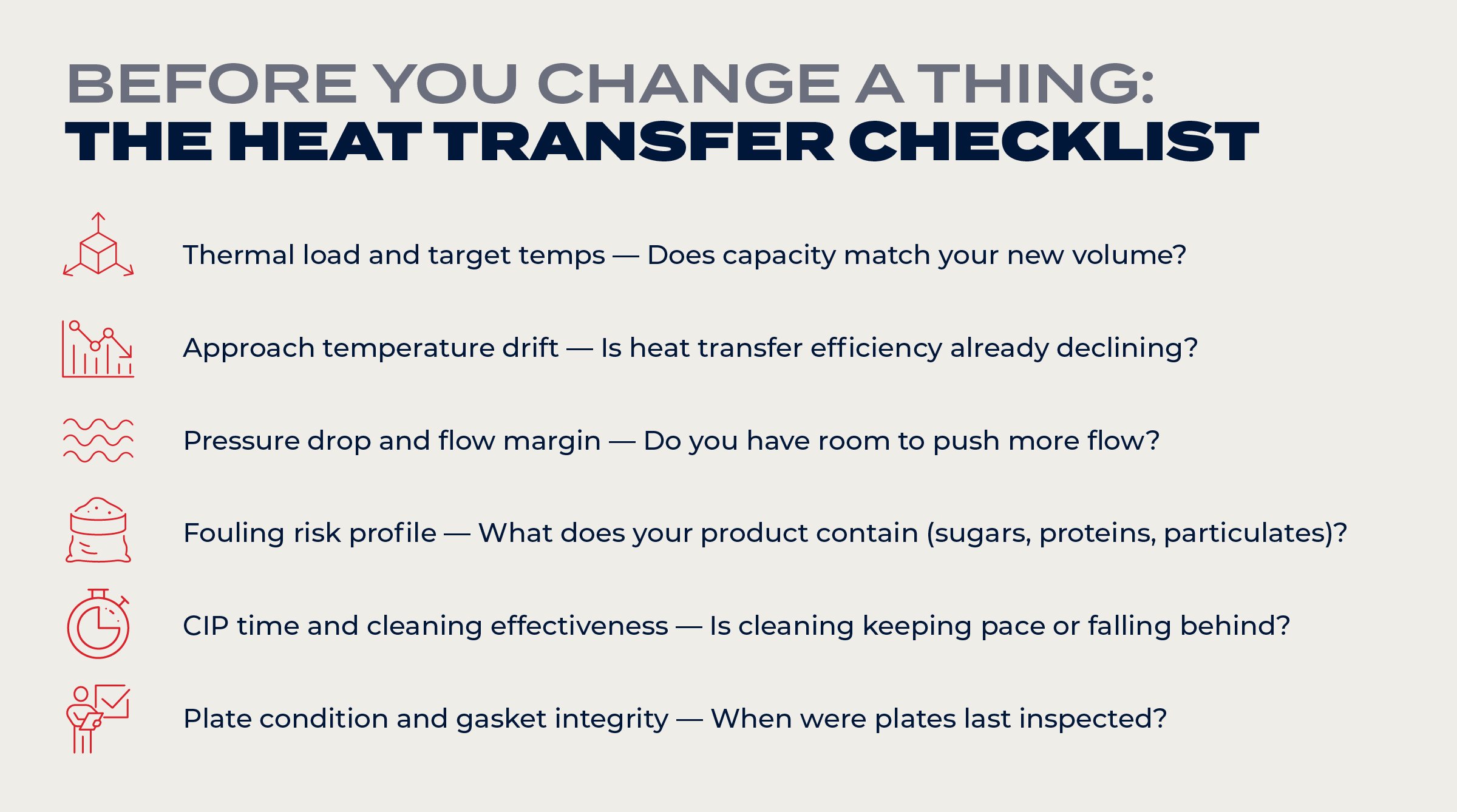
Before committing to a new formulation or throughput target, run through these six checkpoints on your plate and frame system:
Thermal load and target temps — Does the system have the capacity to reach and hold target temperatures at your new volume? Compare your original spec sheet to where you're actually operating today.
Approach temperature drift and heat transfer efficiency — A rising approach temperature (the gap between the two fluid outlet temperatures) is a leading indicator of fouling or plate degradation. If it's trending up, plate and frame heat exchanger efficiency is already declining.
Pressure drop and flow margin — Higher viscosity and fouled plates both increase pressure drop. Know your pump's operating curve and confirm you have flow margin before you push more volume.
Fouling risk profile — What does your new product contain? Sugars, proteins, and particulates each have distinct fouling behaviors that require different CIP approaches and inspection intervals. Inspenet's overview of fouling control in plate heat exchangers is a useful reference for understanding how different fouling mechanisms develop and what they demand from your cleaning protocol.
CIP time and cleaning effectiveness — How long are your current CIP cycles, and are they achieving full cleans? Benchmark this now, before you add product complexity.
Plate condition and gasket integrity — When did plates last get inspected? Corroded, pitted, or warped plates don't transfer heat efficiently and can compromise sanitation. Gaskets that are compressed past their service life affect both sealing and flow distribution.
If any of these checkpoints surface a concern, that's your signal, and it also tells you which fix path to take.
A Maintenance Cadence That Matches Your Volume
Reactive maintenance on heat exchangers costs more than planned maintenance — in parts, in labor, and in downtime. For facilities with predictable seasonal swings, the window before peak demand is the right time to inspect, not after a mid-run failure.
A practical cadence for most food and beverage operations:
Pre-season inspection: Plate condition, gasket integrity, and pressure mapping before high-demand periods.
Mid-season check: Monitor approach temperature trending and CIP cycle time — watch for drift.
Post-season service: Full clean and inspection; document any wear to inform planning for the following year.
If your production calendar has predictable peaks, your heat exchanger service schedule should match it.
Is Your Heat Transfer System Ready for What's Next?
Whether you're introducing a new product, scaling for a volume spike, or troubleshooting performance that's been declining, AGC's service team can assess where your plate and frame system stands, and what it will take to keep it running at full efficiency.
Contact us today to discuss options.

Topics: Maintenance | Service